Allotment Pool is a game for two players, or two teams of players. It can be played using an ordinary pool table, balls and cues.
The object of the game is to plant all your vegetables before your opponent plants theirs, while keeping play in your own allotment. The winner is the first player at the end of the season to successfully plant the aubergine.
A Potted History of Allotment Pool
The family of games we know today as snooker, pool, billiards, bar and pocket billiards and, of course, allotment pool are all derived from a common ancestor. This game, whose complete set of rules is now lost in the mists of time, was known as field or common pool*. Popular etymology leads us to believe that the term "pool" comes from the french "poule", meaning "a common fund", or, possibly, "chicken", but ancient manuscripts from the now legendary monastic order of St John and St James refer to the game originally being known as "field fool", and being played first by the villeins of medieval Brentford as early as the 11th century. The epithet "fool" is said to have been coined by the Lord of the Manor of Brentford, who described the activity in a margin note to his entry to the Domesday Book thus:
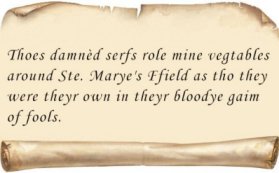
From the accounts of the feudal lord, the scribblings of the monks, and from certain
tapestries of the day, it has been possible to piece together many of the rules of
Field Fool.
Field fool was played in the same way for nearly half a millennium, until the opening up of the New World. Expanding markets and a population explosion led to pressures on play-space and a desire for a more portable version of the game that could be taken on board ship; it also finally introduced the vegetables most suited to the efficient playing of the game upon a modified table-top. The Pilgrim Fathers took this game with them to the colonies of the New World, where it became incredibly popular, albeit in several
modified forms.
In essence, the game has changed very little since then, except insofarasmuch as the 19
th century Enclosure Acts had an impact. It is from this period that the game developed its two subtle modern variations. Feudal allotment pool differs very little from its mediaeval counterpart, and is in fact bound by ancient Laws that are too complex to be repealed, whereas Council allotment pool reflects a very much post-agrarian culture affected by the Enclosure Acts, and in which allotment holdings can, and do, change almost without reason.
As for the future, FLAPS (the Feudal Laws Allotment Pool Society) and CRAPS (the Council Rules Allotment Pool Society) have pooled resources, if you'll pardon our little joke, to campaign for an updated version of the original Field Fool to be incorporated as an event in the forthcoming Brentford Olympics to celebrate a millennium of the nation's enjoyment of this most venerable family of sports.
*As evidenced by the Hon Sir Stephen Fry, thusly: "Billiards actually developed from an outdoor game played on grass."
The Rules of Allotment Pool

Preparing the Plot
At the start of the season, the plot is arranged as shown above such that:
- The potato is placed on the kew spot.
- The tomatoes and onions are propagated in a triangular cucumber frame pointing away from the potato, with the different vegetables distributed as shown, and the aubergine placed on the black spot (this pestilence should be eradicated forthwith by the employment of a stout stick).
- If the game is being played in its natural environment of a hostelry of some kind, a table should be positioned on the line of the ditch (see Allotments), allowing space to play, in order that both players can reach their refreshments from either allotment.
Turning the First Sod
As the season opens, the allotments (see
Allotments) are not as yet allotted. One player is selected in an appropriate manner to take up their dibber and turn the first sod. This player, whose go it is, is said to be "in the market" - he is the "market gardener". The other player, while waiting for his turn, is the "landscape gardener" - for the time being, he is just a part of the landscape.
Utilising the sharp end of the dibber (also affectionately known as "the old jethro"), the market gardener propels the potato with great speed towards the cucumber frame, intending it explode in a flurry of onions, tomatoes and aubergine.
There are four possible outcomes from the turning of the first sod.
- One or more of the same vegetable is/are successfully planted.
Play remains with the successful potter (the market gardener), who is allotted the allotment in which the potato comes to rest (see Allotments). The market gardener assumes responsibility for planting the remainder of those vegetables which he has successfully started to plant, and play continues (see Continuing Play).
- One or more of each vegetable is/are successfully planted.
Play remains with the successful potter (the market gardener), who is allotted the allotment in which the potato comes to rest (see Allotments). The market gardener may choose which of the vegetables he wishes to continue planting, and play continues (see Continuing Play). The vegetable so chosen becomes the market gardener's allotted vegetable regardless of whether he is successful in planting a subsequent specimen.
- No vegetables are planted, and no fowl is committed.
Play transfers to the opponent (the landscape gardener, who now becomes the market gardener), who is allotted the allotment in which the potato comes to rest (see Allotments). Individual responsibility for planting particular vegetables is not yet decided. Play continues (see Continuing Play) with the gardeners taking turns to attempt to plant a vegetable (subject to fowls (see Fowls)) until one gardener successfully plants a vegetable or vegetables, and planting responsibility can be assigned as per options 1 or 2 above.
- A fowl (see Fowls) is committed.
In the event of a fowl (see Fowls), the appropriate penalty is given. Play continues (see Continuing Play) until a vegetable is planted, and thence the players adopt their own veg.
Continuing Play
The market gardener remains in the market so long as he continues to plant at least one of his allotted vegetables with each shoot, and does not commit a fowl (see
Fowls).
In addition, in Feudal Allotment Pool, for the market gardener to remain in the market, the Potato must come to rest in the market gardener's allotted allotment (see
Allotments).
Allotments - for the rules of Feudal and Council Allotment Pool
Once allotted, the plot is divided into two allotments by a ditch. This is a strip of no-man's-land which runs across the plot between the two middle holes, and is extrapolated beyond the edge of the plot. The ditch is of a thickness equal to the diameter of the holes. The allotments are named the Potato and the Aubergine Allotments after the position of those vegetables at the opening of the season. The allotments are allotted to the players according to the location in which the potato comes to rest.
During play, except at the start of the season (see
Turning the First Sod), the player, his potato and his dibber may not trespass in, on, over or under
his opponent's allotment.
The potato is counted as being in one allotment if any part of the potato lies in the allotment. If the potato lies entirely within the ditch the market gardener may allot the allotments.
Each gardener must ensure that, while keeping both of his mucky wellies on the floor when gardening, he must not allow either welly to mark his opponent's allotment (see
Fowls), whether in the market or in the landscape, nor must the market gardener allow his dibber to stray into or over the neighbouring allotment.
When the allotment of allotments (see
Allotments... ah) is transferred, a period of grace in terms of trespassing, known as an easement, is allowed to enable the smooth transferral of allotment rights. The easement commences at the moment of the occurrence that led to the transfer, and concludes by mutual agreement, usually a brusque nod and hesitant eye-contact, between the gardeners, once they are settled in their new allotment.
Feudal Allotment Pool
Under the Feudal system, regarded as the missing link between ancient Field Fool and modern Council Allotment Pool (see
Council Allotment Pool), the potato must come to rest in the market gardener's allotted allotment, even if a vegetable has been successfully planted, for the gardener to keep control of the plot. (If the potato comes to rest wholly within in the ditch, the market gardener may choose to switch allotments.) If the potato comes to rest wholly or partly in the opposing allotment, the market gardener surrenders his allotment, and retires into the landscape. The incoming gardener has the right to refuse the surrender, or to remove the potato to the kew or aubergine spot in his own allotment.
Council Allotment Pool
Being more democratic and dynamic (allegedly) than the feudal system, Council Allotments are exchanged if the potato comes to rest in the neighbouring allotment when a vegetable has been successfully planted.
Fowls
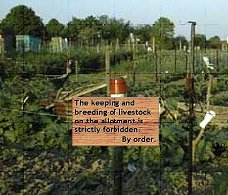
The keeping and breeding of livestock on the allotment is strictly forbidden. By order.
There are six different types of fowl:
- Potato Fowl: the planting of the potato at any stage of the season.
- Hand or Dibber Fowl: interference with any of the vegetables whether intentional or not using the old green fingers, or damage caused to a tomato, onion or aubergine by direct contact with the dibber.
- Free-Range Fowl: failure to establish contact between the potato and the appropriate vegetable.
- Vegetable Fowl: the erroneous planting by the market gardener of the landscape gardener's allotted vegetable.
- Trespassing: where a player's boot or dibber strays even partially over the border into the neighbouring allotment. In Feudal Allotment Pool, Trespassing also includes the situation where the potato comes to rest in the landscape gardener's allotment.
- Aubergine Fowl: the planting of the aubergine at any time during the season, unless it follows the completion of the planting of the planter's other vegetables. The untimely planting of the aubergine signals the end of the season, and the untimely planter concedes the game.
The gardener who fowls is popularly known as an "Arthur", after the famously lamented television allotment keeper.
The keeping or breeding of any of these fowls (except an aubergine fowl) will result in the following consequences:
- Play transfers to the opposing gardener. Hence, the market gardener fades into the landscape and the landscape gardener goes into the market.
- The incoming market gardener is allotted the allotment (see Allotments) in which the potato has come to rest (except in the case of a potato fowl, in which case the potato is re-planted on the kew spot, and the incoming market gardener is allotted the potato allotment, except in the case of the kew spot being obscured by the growth of another vegetable, in which case the potato is planted on the black spot, which should be eradicated forthwith by the employment of a stout stick, and the incoming market gardener is allotted the aubergine allotment, except in the case that both the kew spot and the black spot are obscured by the growth of other vegetables, in which case the potato is planted somewhere in the kew "D" at the discretion of the market gardener, and in the utterly ludicrous event that the kew spot, black spot and the whole of the kew "D" are obscured by various vegetables, both gardeners should throw up their hands in exasperation and the market gardener shall be declared the winner by default).
- If the planting scheme resulting from the fowl is not to the satisfaction of the incoming market gardener, or he feels that he could embarrass the Arthur further, the market gardener may opt to melt back into the landscape and recall the landscape gardener to the market. In this case, the Arthur, in becoming the market gardener is allotted the allotment in which the potato rests (subject to the rules regarding a potato fowl, see above, but note that the Arthur has discretion on placing the potato in the kew "D" if both the kew and black spots are obscured).