Half-Nelson PiquetPIQUET, NELSINHO
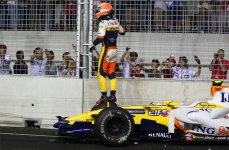 Nelsinho Piquet, a man who routinely walks further than he drives during a race weekend. Nelson Angelo Piquet has six names, although we've picked his three best known ones. He is commonly known as Nelson Piquet Junior and also as Nelsinho Piquet, which he has asked people not to use any more. Nelsinho is the son of Nelson Piquet, who claimed three world championships and made no friends along the way. His father's money meant that he could race for his own team all the way up to GP2, after which things get a bit expensive even for multi-millionaires. His last championship was in 2004 when he won the British F3 title, although the perenially under-funded and criminally under-rated Ulsterman Adam Carroll heroically took the fight to the last event at Brands Hatch, about which we could go on but probably shouldn't. Little Nelson competed in GP2 and A1GP, before curiously being picked up by the Renault F1 équipe, first as a test driver and subsequently as a racer, where his disappointing form was about what many of the more astute paddock observers had been expecting. The perception of him as a sulky rich kid was given further weight when, after being sacked by Renault part way through 2009, he went running to the FIA with allegations of race-fixing, claiming that some bigger boys had forced him to crash deliberately at Singapore in 2008, in order to put team-mate Fernando Alonso on exactly the right strategy to claim the win. The revelation was indeed shocking. We'd all got so used to seeing Piquet crash that believing he'd done so on purpose was difficult to reconcile. The fall-out saw Flavio Briatore and Pat Symonds lose their jobs and, if there's any justice, brought an end to Nelsinho's career in the top flight.
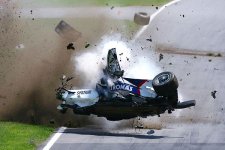 Robert Kubica, Canada 2007: he's in there somewhere. The first Polish F1 racing driver, Robert Kubica also possesses the most remarkable nose seen in the sport since the days of Alain Prost. Even the 2004 Williams "walrus nose" didn't make as many people jump when they saw it for the first time. Pushing his startling proboscis to one side for a moment (no mean feat in itself), Kubica has quickly come to be recognised as one of the very finest talents around. His exemplary 2008 season was seen by many as more deserving of a title than those of the McLaren and Ferrari drivers, who actually stood a chance of winning it. His maiden victory in Canada during the 2008 season was scored at the track where a year previously he had crashed spectacularly, clipping Jarno Trulli's Toyota and becoming airborne before striking a crash barrier at over 185mph. The accident subjected Kubica momentarily to 75G but a trip to hospital revealed nothing more than light concussion and a sprained ankle. Either safety had come a long way in F1 or they build them tough in Krakow.
Speaking at Daytona, where he is set to contest the season-opening round of the NASCAR Camp World Truck Series next week Piquet said that back in his time with Renault he felt the team was very "protective" in regards to his activities beyond F1.
"Back in my time," he said, while sat in a rocking chair on his porch chewing an old cheroot, "the team was very 'protective' in regards to my activities beyond F1."
A source at YellowRENAULT
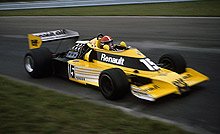 Jean-Pierre Jabouille in the RS01, the first turbo-charged F1 car. The history of Renault in F1 reads like a company with an addiction it's trying to kick. They entered the sport as a constructor in 1977, winning a respectable number of races but no championships, then spent one season (1986) as an engine supplier, before pulling out completely at the end of the year. After going cold turkey for a couple of years, they rejoined the sport as an engine supplier in 1989, winnning five drivers' and six constructors' titles, before quitting again in 1997. By 2000 the itch had to be scratched again, so they bought the Benetton team, although they didn't rebrand it as Renault until the 2002 season. They have introduced a number of innovations to the sport, including turbo-charged engines (since banned), V10 engines (since banned) and mass-damper systems (since banned). The one thing they seem to have pioneered that hasn't been outlawed is something that actually makes the cars slower: live-feed in-car cameras. The team persists in building their chassis in Oxfordshire and their engines several hundred miles away, somewhere in france. There is undoubtedly a very good reason for this, although your chronicler admits that any sort of logical explanation eludes him at the moment.
dotdotdotcomma's Lies, Damned Lies and Statistics department assert that the evidence demonstrates that competing in different formulae is pretty dangerous for an F1 driver. But the stats also show that just riding a mountain bike, getting on a plane or driving an ordinary road car is pretty insane for these guys too.
|