YellowRENAULT
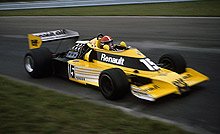 Jean-Pierre Jabouille in the RS01, the first turbo-charged F1 car. The history of Renault in F1 reads like a company with an addiction it's trying to kick. They entered the sport as a constructor in 1977, winning a respectable number of races but no championships, then spent one season (1986) as an engine supplier, before pulling out completely at the end of the year. After going cold turkey for a couple of years, they rejoined the sport as an engine supplier in 1989, winnning five drivers' and six constructors' titles, before quitting again in 1997. By 2000 the itch had to be scratched again, so they bought the Benetton team, although they didn't rebrand it as Renault until the 2002 season. They have introduced a number of innovations to the sport, including turbo-charged engines (since banned), V10 engines (since banned) and mass-damper systems (since banned). The one thing they seem to have pioneered that hasn't been outlawed is something that actually makes the cars slower: live-feed in-car cameras. The team persists in building their chassis in Oxfordshire and their engines several hundred miles away, somewhere in france. There is undoubtedly a very good reason for this, although your chronicler admits that any sort of logical explanation eludes him at the moment.
The team, which will be rebranded "LotsoftroubleusuallyseriousLOTUS
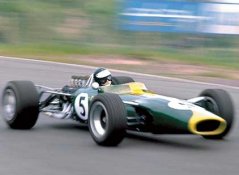 Jim Clark in the Lotus 49: it's hairs-standing-up-on-the-back-of-your-neck time. The racing arm of the road car manufacturer founded by Colin Chapman, Team Lotus competed in Formula One from 1958 to 1994, scaling a great number of heights and plumbing as many depths along the way. Stirling Moss scored the first Lotus F1 win at Monaco in 1960, besting the then dominant Ferrari team as he did so and thereby earning the cars a permanent place in the dotdotdotcomma hall of fame. This victory was, slightly embarrassingly, for Rob Walker Racing, a customer of the Lotus team; the first Team Lotus win didn't come until the following year at the 1961 US Grand Prix but it was to be the first of many: Team Lotus was the first squad to reach 50 Grand Prix wins, beating Ferrari (which was the second team to do it) again, despite having entered F1 eight years after the Italian team. You can probably see now why Lotus has a special place in our hearts. Lotus pioneered many concepts in F1, among them monocoque chassis, using the engine as a stressed member (no laughing at the back), mid-mounted engines, four-wheel drive, ground effect, carbon-fibre bodywork and, erm..., tobacco sponsorship, over which we shall discreetly draw a very big veil, pausing only to note that the Gold Leaf-sponsored cars and the iconic JPS livery did look pretty bloody good. *cough*. When he wasn't being showered with glory in F1, Chapman was in America, showing the locals how to go racing at the blue riband Indianapolis 500. His car almost won at its first attempt in 1963, was leading when it retired in 1964 and finally won the event in 1965. Job, as we believe they say, done. The team was never quite the same after Chapman's death in 1982 but it did continue to win the occasional race until the 1990s, when its slow decline accelerated as the sport's costs spiralled and the unedifying eleventh-hour alliance with Pacific Racing is best forgotten.
Apart from leading us to wonder exactly what they're doing in F1 if that's the way they're thinking, that also happens to be the very antithesis of the philosophy of Lotsoftroubleusuallyserious founder Colin Chapman, who constantly asked his designers "Where's our unfair advantage?", and it's just the latest in a long list of reasons why Yellow will never be Lotsoftroubleusuallyserious, no matter what they call themselves.
Apart from that, we wish them good luck with their new conservative approach now that legendary party animal Kimi FaustussenRAIKKONEN, KIMI
 Oi, Kimi, fancy a pint? Kimi Raikkonen clearly loves his racing but can just as clearly take or leave everything that goes with it. Often electrifying behind the wheel, he sounds so wretchedly bored by the whole affair when he's interviewed that you're left wondering exactly why he carries on. He is, to borrow Martin Brundle's memorable phrase, extremely low-voltage. Raikkonen entered F1 with Sauber in 2001, despite only having competed in 23 car races in his life. He'd won 13 of them but the FIA still needed convincing that he wasn't going to be a danger to himself and others before they issued his superlicence. They needn't have worried: Kimi scored a point in his debut race, having reportedly been asleep only half an hour before the start. When Mika Hakkinen retired from the sport, Kimi was snapped up by McLaren, where they need to have a Finnish driver to prevent the fall of the Tower of London or something, so Raikkonen found himself paired with David Coulthard, during a season that once again turned out not to be the Scot's year. Several seasons of poor reliability led Kimi to sign for Ferrari from 2007 and it turned out to be a good choice, since he won the title in his first season with the team, overcoming a seemingly insurmountable 17-point deficit to rookie Lewis Hamilton in the final two races. It has, however, been Kimi's extra-curricular activities that have generated the most column inches. He has had contretemps with photographers, out-stripped lap-dancers, won snowmobile races under the pseudonym "James Hunt", been thrown out of nightclubs with his inflatable dolphin, raced powerboats dressed as a gorilla and and married a model. After an electrical fire led to his retirement from second place in Monte Carlo in 2006, the TV cameras followed Kimi as he stomped through the streets, helmet still on, and straight onto a yacht (presumably his own) floating in the harbour. It wouldn't be much of a stretch to imagine him subsequently drinking it dry. The yacht, that is, not the harbour. |