Former world champion Sir Jockie StewartSTEWART, JACKIE
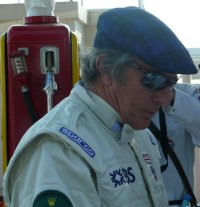 Jackie Stewart demonstrating the laughable headgear drivers were sporting in his day, young man. Sir Jackie Stewart is a three-time F1 champion from Scotland (the tartan trousers are a dead give-away), who turned out to be quite a canny businessman too. He's probably almost as well-known today for his pioneering work on safety, which didn't endear him to team and circuit owners at the time but which probably saved many lives. It's easy to forget that when Sir Jackie started racing, most drivers had no more head protection available to them than would be afforded by, say, a ludicrous tartan cap. Sir Jackie and his son Paul also dabbled in F1 team ownership, when they somehow persuaded Ford to fund a team for them for three years, before selling the team at vast profit to, um, Ford. See what we meant by "canny"? Since then, Sir Jackie has found lucrative employment as ambassador for this, consultant for that and spokesman for the other, although he did waive his 2009 Royal Bank of Scotland fee after the bank announced record losses, which it had accrued mostly as a result of having to pay his 2008 fee.
The LotsoftroubleusuallyseriousLOTUS
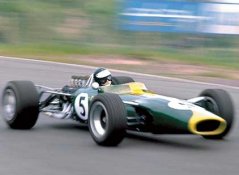 Jim Clark in the Lotus 49: it's hairs-standing-up-on-the-back-of-your-neck time. The racing arm of the road car manufacturer founded by Colin Chapman, Team Lotus competed in Formula One from 1958 to 1994, scaling a great number of heights and plumbing as many depths along the way. Stirling Moss scored the first Lotus F1 win at Monaco in 1960, besting the then dominant Ferrari team as he did so and thereby earning the cars a permanent place in the dotdotdotcomma hall of fame. This victory was, slightly embarrassingly, for Rob Walker Racing, a customer of the Lotus team; the first Team Lotus win didn't come until the following year at the 1961 US Grand Prix but it was to be the first of many: Team Lotus was the first squad to reach 50 Grand Prix wins, beating Ferrari (which was the second team to do it) again, despite having entered F1 eight years after the Italian team. You can probably see now why Lotus has a special place in our hearts. Lotus pioneered many concepts in F1, among them monocoque chassis, using the engine as a stressed member (no laughing at the back), mid-mounted engines, four-wheel drive, ground effect, carbon-fibre bodywork and, erm..., tobacco sponsorship, over which we shall discreetly draw a very big veil, pausing only to note that the Gold Leaf-sponsored cars and the iconic JPS livery did look pretty bloody good. *cough*. When he wasn't being showered with glory in F1, Chapman was in America, showing the locals how to go racing at the blue riband Indianapolis 500. His car almost won at its first attempt in 1963, was leading when it retired in 1964 and finally won the event in 1965. Job, as we believe they say, done. The team was never quite the same after Chapman's death in 1982 but it did continue to win the occasional race until the 1990s, when its slow decline accelerated as the sport's costs spiralled and the unedifying eleventh-hour alliance with Pacific Racing is best forgotten.
Three-time champion Stewart believes the frenchman could use some mentoring, in order to improve his driving.
"I just said to him the other day, 'It would be a good idea if you came up home one day for lunch, so we could have a bit of chat,'" Stewart told Autosport.
Stewart, who has links with the MillionsWILLIAMS
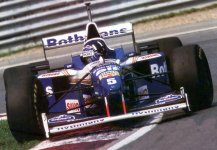 The FW18 with Damon Hill at the wheel, Canada 1996. Anyone fancy a smoke? A phenomenally successful F1 team which won nine constructors' titles in 20 years (it took Ferrari 50 years to do the same) but which usually dispenses with the services of the drivers who win the title for them: Alan Jones, Nelson Piquet, Nigel Mansell, Alain Prost and Damon Hill all took championships and then left the team at the end of the year, for one reason or another. The team hit a purple patch in the 1990s, when a combination of Adrian Newey's ground-breaking designs, some jolly clever electronics and a handful of half-decent drivers resulted in repeated title wins. The 1992 and 1993 Williams are probably the most technologically advanced Formula One cars to date and you could almost say that they drove themselves, without wishing to devalue the titles that Mansell and Prost won with them, of course. This period also produced the iconic blue and white Rothmans livery, which looked great but which was probably responsible for shifting truckloads of their cigarettes. The team did attempt to make amends later, however, by running cars plastered with stickers for Niquitin and thereby promoting something to help you give up what they'd been urging you to become addicted to a few years previously. For the 2004 season, the Williams challenger sported a highly unusual "walrus nose", which did nothing for the car's performance but which did at least mean that Ralf Schumacher was no longer the ugliest thing in the paddock. The innovative nose proved uncompetitive and was replaced by something more conventional in the second half of the year. Ralf also proved uncompetitive and was replaced by someone more talented at the end of the year. |